Blood Parrot Fish Price in India 2026 and Complete Care Guide
Blood parrots are one of India's most popular large aquarium fish. Current prices by size and grade, honest care requirements, and how to spot a dyed fish.
The blood parrot is a man made hybrid cichlid, most likely a cross of midas and redhead cichlid, and it has become one of the best selling large aquarium fish in India. The round body, permanent smile and bright orange colour do the selling, and it is genuinely hardy, which is why it works for people upgrading from a first community tank.
Blood Parrot Fish Price List India 2026
| Type / size | Price (INR) | Notes |
|---|---|---|
| Blood parrot, 1.5-2 inch | ₹150-₹350 | Juvenile, colour still developing |
| Blood parrot, 3-4 inch | ₹350-₹700 | Most commonly sold size |
| Blood parrot, 5-6 inch | ₹700-₹1,500 | Near adult, full colour |
| Blood parrot, 7 inch+ | ₹1,500-₹3,000 | Display size |
| King Kong Parrot | ₹1,200-₹5,000 | Thicker body, deeper red, premium grade |
| Red Mammon / Red Ingot | ₹2,000-₹8,000 | Show grade, intense red, imported lines |
| Golden / yellow parrot | ₹400-₹1,200 | Colour variant |
| Purple / heart tail parrot | ₹500-₹1,500 | Selectively bred tail shape |
| Panda / calico parrot | ₹400-₹1,000 | Black and orange patterning |
Parrot fish available now at Kolathur Fish Market
See all with live pricesThese are our current catalogue prices. The ranges in the guide are typical market prices across India.
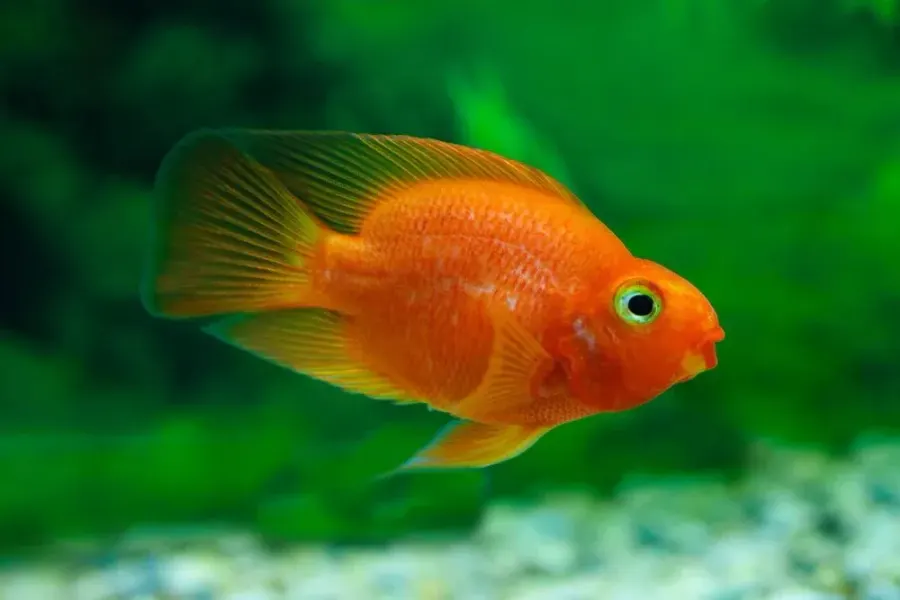
⚠️Avoid dyed parrot fish sold as blue, purple, green or pink "jellybean" parrots. The colour is injected or applied through a chemical dip, it fades within months, and the process kills a large share of the fish before they even reach the shop. Natural parrot colours are orange, red, yellow, and occasionally black and white patterning.
Tank Requirements
- Minimum tank: 3 feet for one, 4 feet for a pair, 5 feet or more for a group.
- Volume: roughly 100 litres for the first fish and 40-50 litres for each additional one.
- Temperature: 25-30°C. They are comfortable across most of the Indian year.
- pH: 6.5-7.5.
- Filtration: heavy. Rate the filter at 6-8 times tank volume per hour; parrots are messy eaters.
- Substrate: sand or smooth gravel. They dig and rearrange constantly.
- Decor: caves and pots. Parrots are shy despite their size and need somewhere to retreat.
- Lid: essential, they will jump when startled.
Diet and Colour
Feed a quality cichlid pellet as the staple, twice a day, in amounts finished within two minutes. Supplement with frozen bloodworm, brine shrimp and blanched vegetables. Colour enhancing pellets containing astaxanthin and spirulina genuinely deepen the orange over weeks, unlike dye, which is applied to the fish itself.
Because of their deformed mouth, parrots cannot bite properly and feed by sucking. Use sinking pellets small enough to be swallowed whole, and give slower feeders time; in a mixed tank a parrot is often outcompeted by faster fish.
Tank Mates
| Works well | Avoid |
|---|---|
| Other blood parrots | Any fish small enough to swallow (tetras, guppies) |
| Severums and firemouths | Flowerhorn (will bully a parrot relentlessly) |
| Silver dollars | Oscar in a tank under 5 feet |
| Plecos and large catfish | Fin nippers like tiger barbs |
| Tinfoil barbs and larger rainbowfish | Aggressive African cichlids |
| Kissing gourami and giant danios | Bettas and any long finned fish |
Common Problems
| Symptom | Cause | Fix |
|---|---|---|
| Colour fading to pale orange or white | Stress, poor diet, or the fish was dyed | Improve diet with colour enhancing pellets, reduce stress, check water |
| Black spots or patches appearing | Usually stress marks, sometimes ammonia burn healing | Test water; stress marks fade when conditions improve |
| Hole in the head (pits above the eyes) | Poor diet, high nitrate, activated carbon overuse | Vitamin rich diet, aggressive water changes, remove carbon |
| Floating or sinking, swimming sideways | Swim bladder, often from gulping air while feeding | Fast 2-3 days, feed sinking food, offer a deshelled boiled pea |
| Constant digging and uprooting plants | Normal cichlid behaviour | Use hardy plants in pots, or weighted decor and no delicate plants |
Are Blood Parrots Ethical to Keep?
It is a fair question. Blood parrots are a hybrid with a deformed mouth that cannot fully close and a compressed body, and most are functionally sterile. Some keepers avoid them for that reason. Others point out that captive bred parrots are healthy, long lived (10-15 years), and no more artificial than a fancy goldfish. What is not defensible is buying artificially dyed fish, which creates demand for a process that kills most of the fish subjected to it. If you buy a parrot, buy an undyed one.